The Book of Enoch is one of the most read and most forgotten texts in history. For fifteen centuries it was scripture across much of the Christian world. Then it vanished from most churches entirely. If you've ever wondered what the fuss is about, this is where to start.
What Is the Book of Enoch?
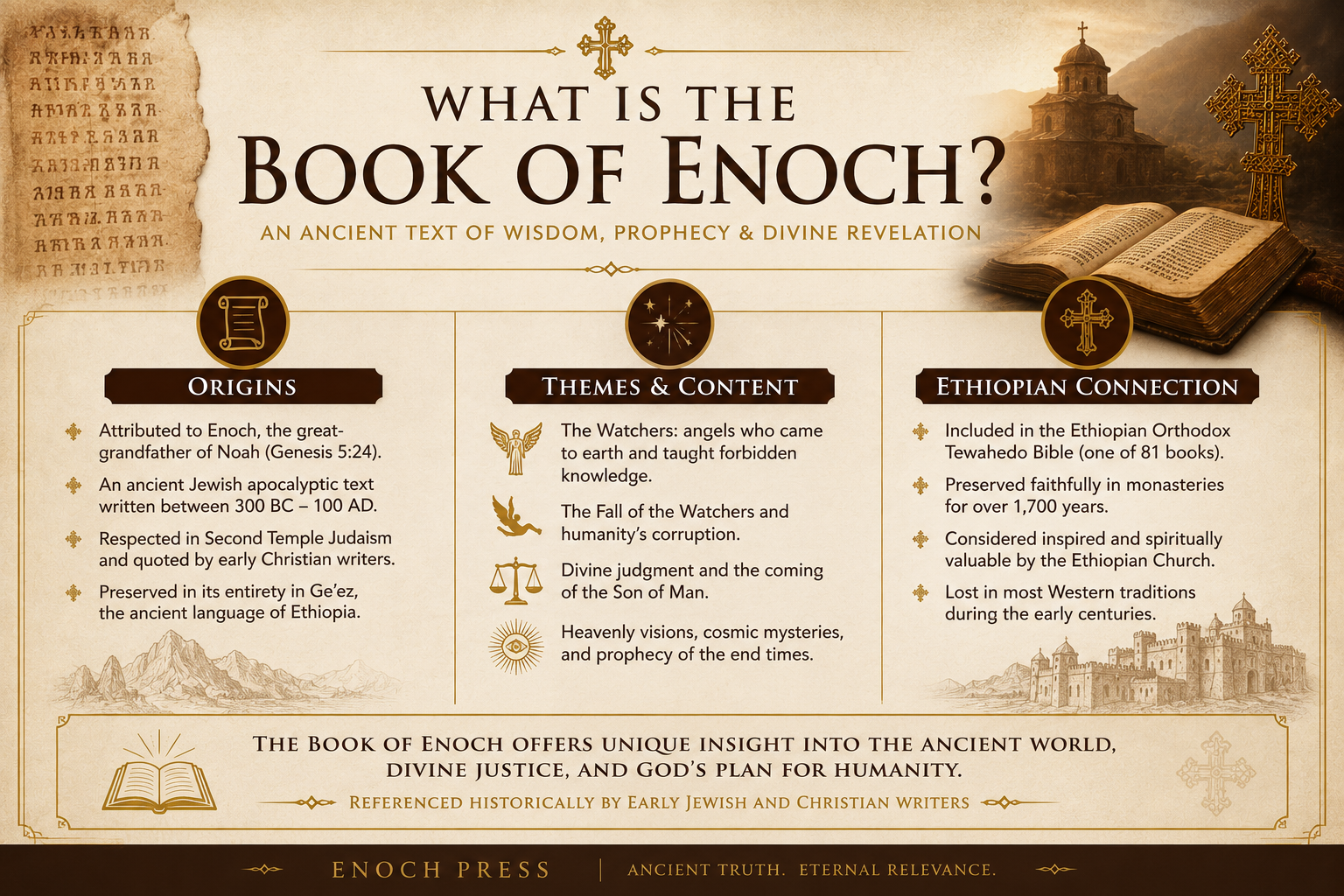
The Book of Enoch (also called 1 Enoch) is an ancient Jewish text composed between the 3rd and 1st centuries BCE. It presents itself as a revelation received by the patriarch Enoch, the great-grandfather of Noah, "who walked with God and was not, for God took him" (Genesis 5:24).
In the Ethiopian Orthodox tradition, it has never stopped being scripture. The Ethiopian Orthodox Tewahedo Church includes 1 Enoch as part of its biblical canon to this day, a canon that contains 81 books total. For Ethiopian Christians, reading the Book of Enoch is not an academic exercise. It is part of the regular spiritual diet.
Western Christians encountered the book primarily through the New Testament. The Epistle of Jude quotes it directly: "Behold, the Lord comes with ten thousands of his holy ones, to execute judgment upon all" (Jude 1:14-15). The phrasing matches 1 Enoch 1:9 so closely that scholars consider Jude's letter evidence the author considered Enoch authoritative scripture. The Book of Daniel, written in the 2nd century BCE, shows similar apocalyptic imagery, and many researchers believe the author was familiar with Enochic tradition.
In 1773, Scottish explorer James Bruce returned from Ethiopia with three complete copies of the book. For decades, Ethiopia was the only place the full text had survived. Fragments surfaced among the Dead Sea Scrolls in the 20th century, confirming that the book was known and circulated widely in the Second Temple period. Scholars date the earliest material to the 3rd century BCE, with later sections added over the following two centuries.
Why Did It Disappear From Most Bibles?
The Book of Enoch was not rejected by a single council decision. Its fate was more gradual and more political than that.
When early Christian councils debated which texts were canonical, several criteria were applied: apostolic authorship or association, widespread use in liturgical settings, and consistency with orthodox teaching. The Book of Enoch met the second criterion in some regions but failed the first. No apostle wrote it, and it was not quoted in the gospels or the earliest Pauline letters.
The eastern church largely set it aside. The western church followed. By the time of the Protestant Reformation, when Martin Luther and his contemporaries took a hard line on scriptural authority, the book was already absent from most European Bible translations. Luther considered it apocryphal and argued against its use in teaching.
The reasons went beyond simple canonicity. Some early church fathers, particularly Augustine, found portions of Enoch troubling: the detailed descriptions of angelic hierarchies and the Watchers' fall seemed to encourage speculation that the text was not meant to support. Enoch also contains apocalyptic material that, in some readings, contradicted emerging orthodox positions on the nature of evil, the origin of demons, and the structure of the cosmos.
The result: a book that was scripture for Ethiopian Christians, quoted by Jude, confirmed by the Dead Sea Scrolls, and present in the oldest surviving complete Bibles was dropped from the canon used by the vast majority of the world's Christians. It survived not in libraries but in monasteries, where Ethiopian monks copied it by hand for fifteen centuries.
What's Inside the Book of Enoch?
The Book of Enoch is not a single coherent narrative. It is a collection of five distinct works, each with its own character and concerns, bundled together under one title.
The Book of Watchers (Chapters 1-36)
The most famous and most dramatic section. It describes the fall of the Watchers: two hundred angels who left their station in heaven to take human wives. Their children, the Nephilim, were giants whose violence corrupted the earth. God sends the Flood to wipe the slate clean, but first the archangel Michael is tasked with binding the Watchers in chains until the final judgment.
Enoch is sent as a messenger to the fallen angels, to deliver their sentence. He travels to the ends of the earth, sees the places of punishment and the trees of paradise, and returns with a commission to write everything down. This section also contains the earliest description of Sheol as a multi-tiered underworld, with separate regions for the righteous and the wicked.
The Book of Parables (Chapters 37-71)
The most theologically dense section and the one most directly connected to New Testament language. It introduces the "Son of Man" who will sit on a throne of glory, execute judgment, and rule over a righteous kingdom at the end of history. The language here is strikingly similar to what appears in the Gospels: the "one like a son of man" who comes on the clouds of heaven.
This section also expands the angelology from Watchers: a full hierarchy of archangels named for the first time anywhere in literature. Uriel, Raphael, Michael, Gabriel, and Suriyyel each have assigned domains. The Book of Parables may be the oldest source for these names, predating later Jewish and Christian angelologies.
The Astronomical Book (Chapters 72-82)
A meticulous description of the solar calendar, the paths of the sun and moon, and the angelic watchers who guard the celestial gates. This section reads almost like a technical manual, describing solstices, equinoxes, and the precision of the heavenly order. Scholars believe it reflects a 364-day solar calendar used by some Second Temple communities, including the community at Qumran.
The Book of Dreams (Chapters 83-90)
Enoch recounts two dream visions. The first describes the pre-diluvian world and the coming of the Flood as divine judgment. The second, longer vision uses an elaborate animal allegory to describe the history of Israel from the patriarchs through the Maccabean revolt. The animals represent successive generations, and the imagery is dense, strange, and sometimes difficult to follow. But the vision ends with a clear promise: after the long night of violence and apostasy, a white bull will emerge and birth a holy seed.
The Epistle of Enoch (Chapters 91-108)
The most didactic section. Enoch writes to his descendants, urging them to pursue righteousness and warning against the "builders of unrighteousness." It contains one of the earliest explicit statements of afterlife judgment, with separate fates for the righteous and the wicked. The final chapter is an earnest appeal to future readers: the books will be preserved, and one day the righteous will inherit the earth while the unrighteous burn.
How to Study the Book of Enoch Today
The full text is widely available in English translation. The most reliable scholarly edition is R.H. Charles's translation, updated in many modern editions. Nickelsburg and Collins have produced excellent commentaries for academic readers. For general readers, the Ethiopian Orthodox Bible translation includes the Book of Enoch in its proper place.
A few approaches work well. Start with the Book of Watchers for narrative drama. Move to the Book of Parables if you want to understand the "Son of Man" language that appears in the New Testament. The Epistle of Enoch reads most naturally as a letter, so save it for last if you prefer a linear path.
The Dead Sea Scrolls have transformed what scholars know about the book's history. Multiple copies of Enoch were found at Qumran, some in versions slightly different from the later Ethiopic translations. This has made it one of the best-documented texts in Second Temple Judaism.
Read it as a window into the world that produced the New Testament. The ideas Jesus and his first followers argued with, built on, and transformed did not emerge from nowhere. The Book of Enoch is one of the clearest windows into that world.
"Enoch walked with God; then he was no more, because God took him." Genesis 5:24
The book that bears his name is one of the strangest, most visionary, and most historically significant texts to survive from the ancient world. It has outlasted the empires that tried to suppress it and the councils that debated its standing. It is time to read it.