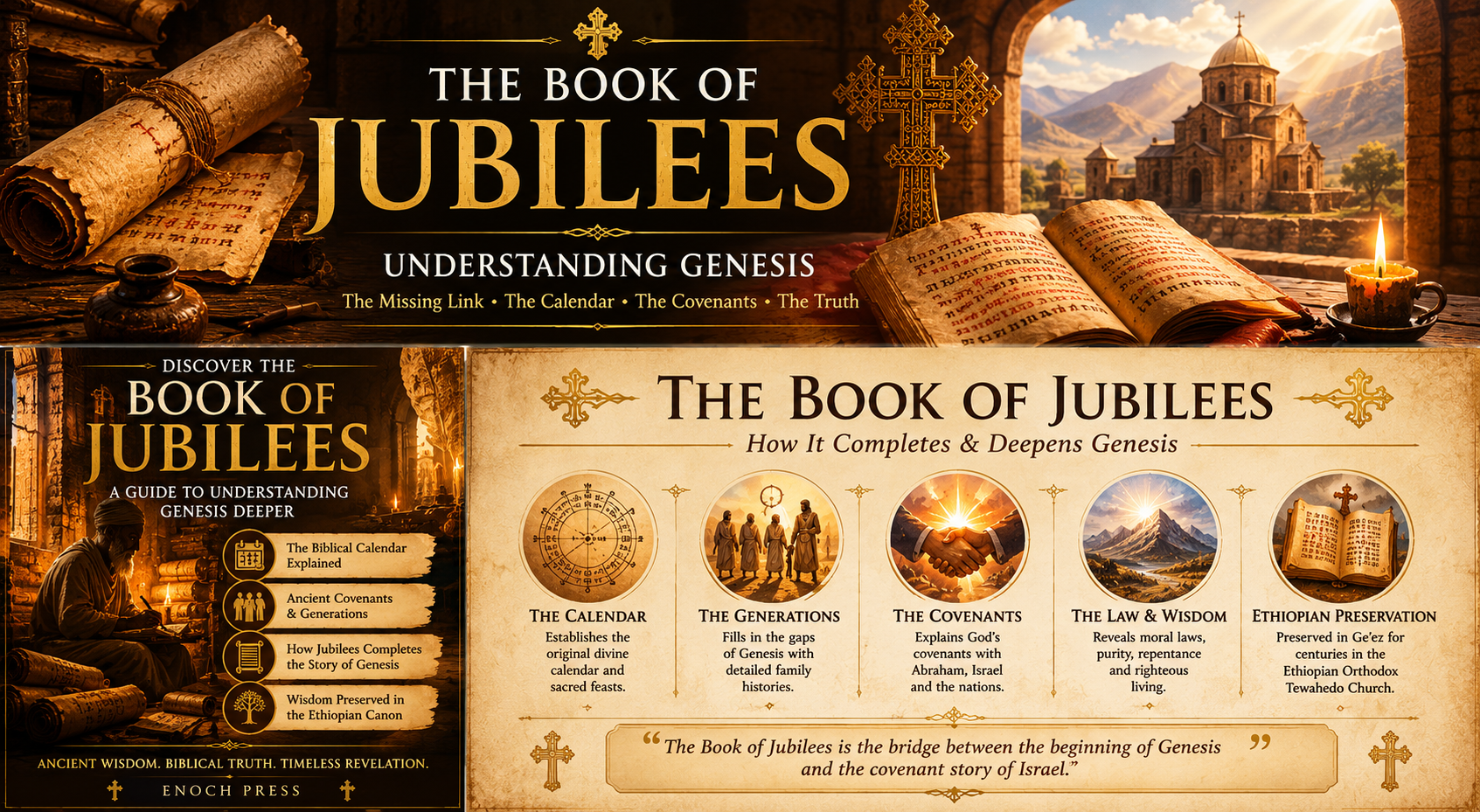
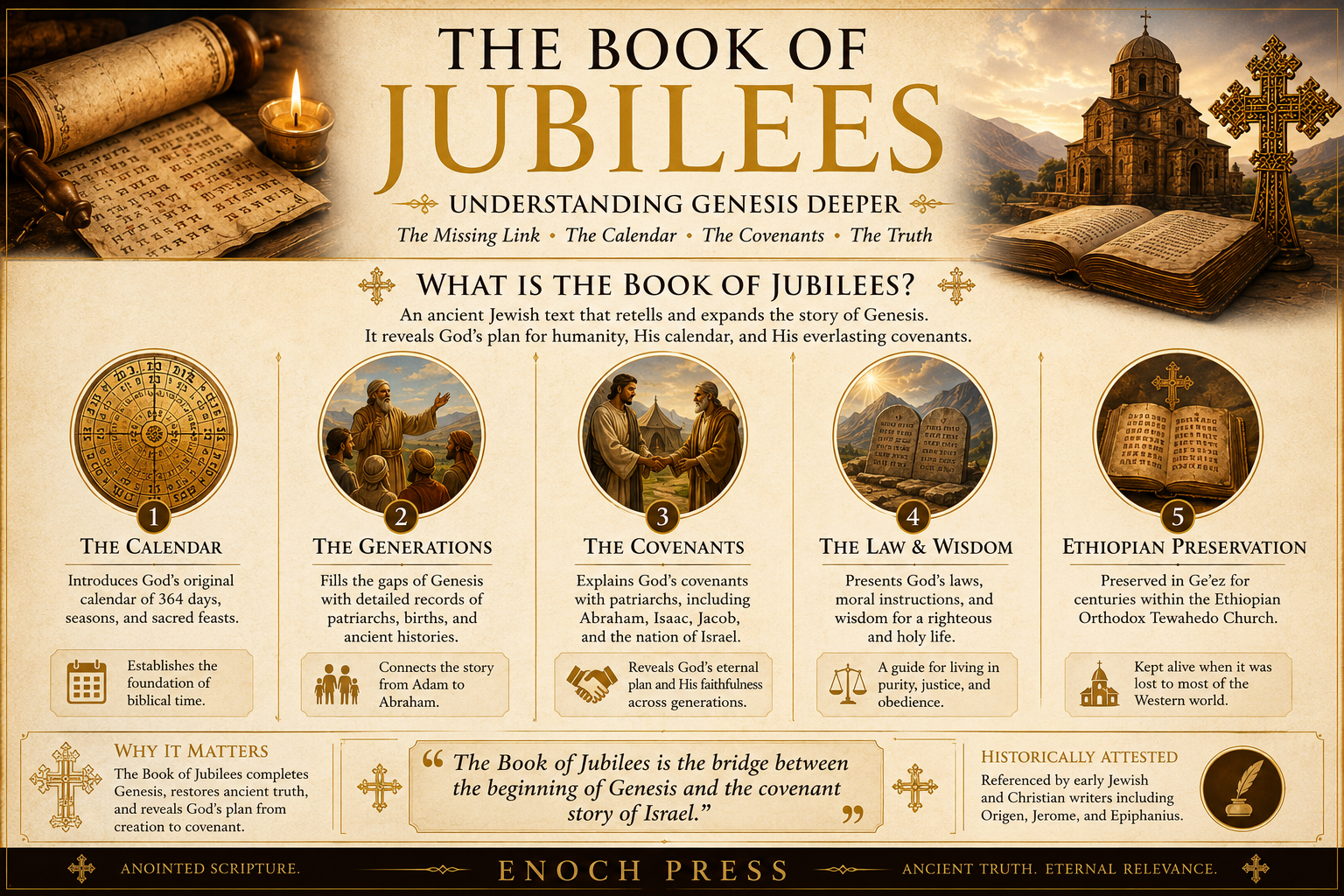
The Book of Jubilees is one of the most underread texts in biblical history. It retells the entire story of Genesis — and part of Exodus — in granular, unapologetic detail, filling gaps the Hebrew Bible leaves open and insisting on a calendar the rest of the world rejected. The Ethiopian Orthodox Church has kept it as scripture for centuries. Most of the rest of the world has barely heard of it.
What Is the Book of Jubilees?
The Book of Jubilees is an ancient Jewish text composed between the 2nd and 1st centuries BCE, most likely during the Maccabean period when the question of Jewish identity and calendar observance was a matter of life and death. It retells Genesis 1 through Exodus 14 in the form of a divine revelation delivered to Moses on Mount Sinai by the Angel of the Presence.
The framing device is simple: Moses receives not just the Torah but a second, more detailed account of the events from creation through the Exodus. This account organizes all of history into units of forty-nine years called "jubilees," each divided into seven "weeks" of seven years. Every event — the creation of Adam, the flood, the call of Abraham — is given a precise date within this system. History, in the Book of Jubilees, is not approximate. It is a timetable.
The text was preserved in its complete form only in Ethiopia, where the Ethiopian Orthodox Tewahedo Church included it in their biblical canon alongside 1 Enoch and other texts long dropped from Western use. Greek and Latin fragments survived in the libraries of early Christian scholars, and in the 20th century Hebrew and Aramaic fragments surfaced among the Dead Sea Scrolls at Qumran — confirming that Jubilees was actively read and copied during the Second Temple period. But the complete text? Only Ethiopia kept it intact.
Why It's Called "Little Genesis"
Early readers and scholars called Jubilees the "Little Genesis" — Leptogenesis in Greek — because it operates as a companion volume to Genesis rather than a replacement. It covers the same ground: creation, Eden, the Fall, the generations before the Flood, Noah, Abraham, Isaac, Jacob. But it covers it in more detail, with more explanation, with more attention to law and calendar and the mechanics of divine judgment.
The name is slightly misleading. Jubilees is not smaller than Genesis — it is roughly the same length. It is "little" in the sense of a condensed or derivative text, the way a commentary stands beside the source it explains. But calling it derivative undervalues it. Jubilees does not merely explain Genesis. It argues with it, supplements it, and in places rewrites it with a different theological agenda.
Where Genesis presents events and leaves meaning open, Jubilees closes the gaps. Why did Cain kill Abel? Jubilees specifies that a prince of demons, Mastema, was involved. Why did God choose Abraham? Jubilees traces it through a detailed genealogy and a series of tests that Genesis abbreviates. The "Little Genesis" has opinions, and it states them plainly.
Key Differences From Canonical Genesis
Several divergences between Jubilees and the Genesis text we have today are significant enough to change how readers understand the early biblical narrative.
The role of angels is explicit. In Genesis, angels appear occasionally and without much explanation — the "sons of God" in chapter 6, the visitors to Abraham in chapter 18. In Jubilees, angels are everywhere. They are present at creation, involved in the affairs of the patriarchs, and organized into a named hierarchy. The Angel of the Presence (later identified with Phanuel or Uriel in some traditions) dictates the entire book to Moses. Angels of the Presence and angels of sanctification were created on the first day, already circumcised, already keeping the Sabbath. The implication is that Israel's practices are not innovations — they are copies of celestial originals.
Mastema replaces or supplements Satan. In canonical Genesis, there is no named adversarial figure in most of the early narratives. Jubilees introduces Mastema — a prince of evil spirits — as an active antagonist who intercedes with God to test Abraham, who hardens Pharaoh's heart, and who attempts to kill Moses en route to Egypt. Mastema is not quite the same as the Satan of later tradition, but he performs many of the same functions and fills a theological gap that Genesis left open.
The timeline is precise and non-negotiable. Genesis gives genealogical ages but not absolute dates. Jubilees converts everything into a fixed chronology. The creation was year one. The Flood was in the year 1307 of the jubilee calendar. Abraham was born in the year 1876. Every event has a date, and the dates are intended to demonstrate that God's plan is not improvised — it is a schedule, and it is running on time.
Women have more presence. Genesis is notably sparse on the names and stories of the women in the patriarchal narratives. Jubilees fills some of these gaps. The wives of the patriarchs are named. Dinah's story, which Genesis compresses into one chapter, receives expanded treatment. The effect is a text more attentive to the full cast of characters than its source.
What Makes It Unique
Three features set Jubilees apart from every other text in the ancient biblical world.
The solar calendar. The calendar at the center of Jubilees is a 364-day solar year divided into four seasons of exactly ninety-one days each, with each season beginning on a Wednesday (the day the sun was created). Sabbaths, feast days, and festivals fall on fixed days of the week, every year, without variation. This is directly opposed to the lunar calendar the Jerusalem temple used — and this opposition was not accidental. For the community that produced Jubilees, using the lunar calendar was not just inconvenient. It was apostasy. The correct calendar was given by God to the angels before creation and revealed to Moses at Sinai. To deviate from it was to misalign Israel with heaven itself. The Qumran community that preserved the Dead Sea Scrolls shared this calendar conviction, which is one reason scholars believe Jubilees was important to them.
The angel hierarchy. Jubilees presents a detailed angelology organized into ranks: Angels of the Presence, Angels of Sanctification, and then descending orders responsible for nature, seasons, and the nations. This is more systematic than anything in canonical Genesis and directly influences later Jewish and Christian angelologies. The Book of Enoch shares this interest, and many scholars believe both texts emerged from related Second Temple communities deeply invested in mapping the invisible world.
Expanded narratives with legal weight. Throughout the book, events from Genesis are retold with additional detail that ties them to specific laws and observances. When Abraham circumcises his household, Jubilees notes the exact date and establishes it as the perpetual ordinance for all of Israel. When Jacob wrestles with the angel, the account becomes the basis for why Israel does not eat the sinew of the hip. The narratives are not just stories — they are legal precedents, and Jubilees makes that function explicit. Every expansion has a purpose: to demonstrate that the laws given at Sinai were not new inventions but confirmations of practices that began at the very beginning of the world.
Why the Ethiopian Orthodox Church Preserved It
The Ethiopian Orthodox Tewahedo Church did not stumble onto Jubilees. It made a deliberate and consistent theological choice to include it, along with 1 Enoch and other texts the Western church dropped, in a biblical canon that now contains 81 books.
Several factors explain this. The Ethiopian church received Christianity in the 4th century CE, largely through Alexandrian influence, at a time when these texts were still in broader circulation and before the Western councils had finalized their narrower canon. The church in Alexandria had a more expansive view of scripture than Rome, and the texts that came to Ethiopia reflected that breadth.
Ethiopian Christianity also developed in close proximity to Ethiopian Judaism — the Beta Israel, who trace their origin to the time of Solomon and maintain their own scriptural traditions. The shared reverence for Enoch, Jubilees, and other Second Temple texts may reflect a common ancient inheritance preserved in the Horn of Africa long after it was abandoned elsewhere.
Once included in the canon, the texts were copied, studied, and defended over centuries of isolated development. The Ethiopian church was geographically remote from the debates that reshaped Western Christianity during the Reformation and the rise of critical biblical scholarship. It had no reason to drop texts it had always considered scripture. So it kept them.
The result is a biblical tradition that gives modern readers access to a fuller picture of Second Temple Judaism than any Western church has preserved. Reading the Ethiopian canon is not an eccentric exercise. It is a window into the broader world of ancient Israelite and early Christian thought before the process of canonization narrowed what counted as scripture.
"Write the complete history of the creation, how in six days the Lord God finished all His works and all that He created, and kept Sabbath on the seventh day." — Book of Jubilees 2:1
The Book of Jubilees is not a footnote to Genesis. It is a witness to how ancient Jewish communities read Genesis, argued about its meaning, and tried to encode their convictions into its story. It deserves to be read on those terms.