Most Christians grew up with a 66-book Bible. The Ethiopian Orthodox Tewahedo Church has used an 81-book canon for nearly two thousand years — and the fifteen extra books are extraordinary.
What Is the Ethiopian Bible?
The Ethiopian Orthodox Tewahedo Church is one of the oldest Christian institutions on earth. Christianity arrived in Ethiopia in the 4th century AD, carried by Frumentius, an Alexandrian traveler who converted King Ezana of Axum. The church that emerged from that encounter developed independently for centuries, preserving texts that the Western councils debated, reinterpreted, or discarded entirely.
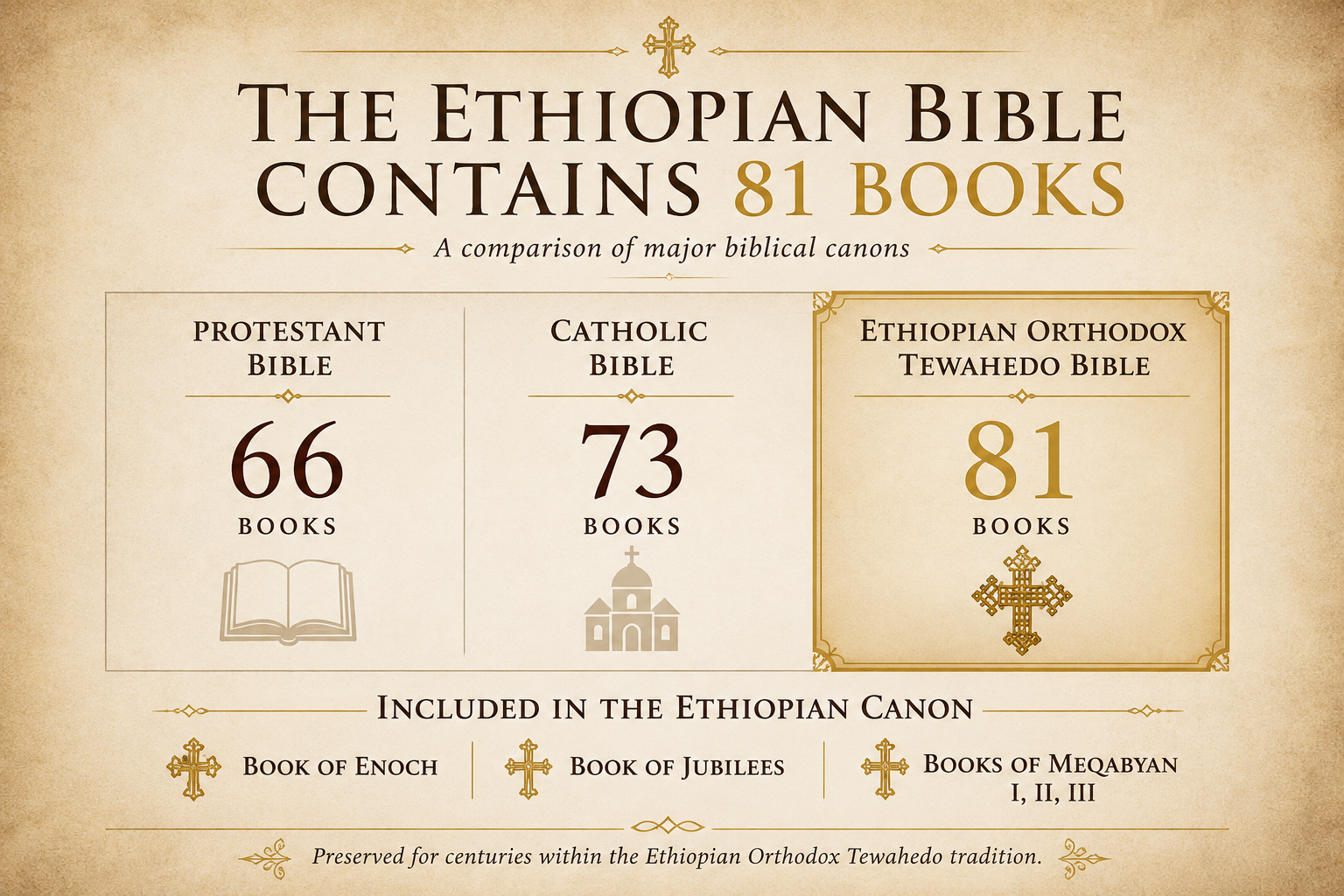
The result is a biblical canon unlike any other. Where the Protestant Bible contains 66 books and the Catholic Bible contains 73 (with the deuterocanonical texts), the Ethiopian Orthodox canon contains 81 — and some scholars count an even broader "narrower" and "broader" canon extending further. These are not obscure footnotes. They are scripture. They have been read from pulpits, memorized by monks, and woven into Ethiopian theology and culture for longer than most Western denominations have existed.
The Books You Have Not Read
The most famous of the Ethiopian-exclusive texts is the Book of Enoch (1 Enoch). In the Western tradition, Enoch is a figure of mystery — he "walked with God, and was not, for God took him" (Genesis 5:24). The Ethiopian canon preserves an entire book attributed to him: a sprawling, visionary work describing the fall of the Watchers (angels who took human wives), the structure of heaven, the coming judgment, and the Son of Man who will reign at the end of days.
Fragments of the Book of Enoch were found among the Dead Sea Scrolls, confirming its ancient origin. The New Testament book of Jude quotes it directly: "Behold, the Lord comes with ten thousands of his holy ones, to execute judgment" (Jude 1:14–15, quoting 1 Enoch 1:9). For centuries, European scholars knew the book only through fragments — until a Scottish explorer named James Bruce brought three complete copies back from Ethiopia in 1773. The full text had survived nowhere else.
The Book of Jubilees retells Genesis and the first part of Exodus in a framework of "jubilees" — 49-year cycles. It gives precise dates to the patriarchal narratives, expands the stories of figures like Abraham and Jacob, and presents itself as a revelation delivered to Moses on Mount Sinai alongside the Torah. The Dead Sea community at Qumran treated it as authoritative scripture. It answers questions the canonical text leaves open: What were the names of the wives of the patriarchs? How did the calendar of heaven work? What happened in the gaps?
Meqabyan (sometimes called Ethiopian Maccabees) is entirely unique to the Ethiopian canon — it has no equivalent in any other tradition. Unlike the Greek Maccabees found in Catholic Bibles, Meqabyan is not a historical account of the Hasmonean revolt. It is a theological work, concerned with monotheism, the dangers of idol worship, and the faithfulness of those who refused to compromise. Three books make up the Meqabyan corpus, and they read as a sustained argument for the singular God of Israel against every cultural pressure to dilute that allegiance.
The Book of Baruch, with the Letter of Jeremiah, appears in the Catholic and Orthodox canons but not the Protestant one. Baruch was the secretary of the prophet Jeremiah. The book attributed to him includes prayers of confession spoken during the Babylonian exile, a poem on the nature of Wisdom, and a letter from Jeremiah warning the exiles against worshipping the idols of Babylon. In the Ethiopian canon it sits alongside Jeremiah as a natural continuation of his prophetic work.
Why These Texts Were Set Aside
The Protestant Reformation of the 16th century produced a deliberate narrowing of the canon. Martin Luther and the reformers looked to the Hebrew Bible of the rabbis — the Masoretic Text, which did not include the deuterocanonical books — and stripped those texts out. The logic was textual and polemical at once: if the Jewish canon did not include them, and Catholic theology used them to support doctrines the reformers opposed (like prayers for the dead, found in 2 Maccabees), out they went.
That decision was not inevitable. It was a choice made in a particular historical moment, against particular opponents, using particular criteria. The Ethiopian Orthodox Church made different choices, guided by different councils, in a different part of the world — and the canon they preserved reflects a broader and in many ways older stream of Jewish and Christian textual tradition.
The books they kept are not lesser scripture. They are earlier in many cases, more closely connected to the Second Temple world in which Jesus and his first followers lived, and full of theological ideas that illuminate the New Testament in ways the 66-book canon alone cannot.
Why This Matters Now
Reading the Ethiopian Bible does not require abandoning your own tradition. It requires expanding your sense of what the tradition contains. The Book of Enoch explains the cosmology behind passages in the Gospels and the Epistles that have long puzzled Western readers. Jubilees fills in the silence of Genesis. Meqabyan shows what monotheistic faithfulness looked like under cultural pressure — a theme that has never stopped being relevant. Baruch gives a human voice to exile and longing.
These texts survived because a community in the Horn of Africa decided they were worth keeping. For fifteen centuries, while the rest of the Christian world forgot them, Ethiopian monks copied them by hand, Ethiopian scholars commented on them, Ethiopian congregations read them aloud. They have been waiting.
"The Ethiopian eunuch said, 'How can I understand, unless someone guides me?'" — Acts 8:31
The world's oldest continuous Christian tradition preserved a Bible larger than most Christians know exists. It is time to read it.